“When all you have is a hammer, everything looks like a nail.”
We’ve all probably heard this comment, or something similar to it, many times… and it makes sense. It’s not unreasonable to use the tools we have at hand to solve whatever challenge is right in front of us. And, if you’re anything like me, you may be willing to “hack” a solution with what you have handy rather than to expend the energy to get the right tool for the job… even when the tool may not be that hard to get to. That same can be true when we’re at work.
If you are familiar with self assessment tools like Clifton StrengthsFinder or the Via Institute on Character, then you’re likely aware of the basic premise of their research: that everyone is good at many things – though not all – and that successful organizations need to recognize this and try to leverage their peoples’ strengths to the betterment of all. Or, to put it more simply – to play to their people’s strengths.
That’s a great perspective to have and, applied properly, can be very empowering to teams and individuals. My caution – which is the basis of today’s post – is not to overplay your strengths simply because you’re good at them.
Let me offer a personal illustration. One of my higher-scoring traits is a strong sense of fairness. I want everyone to have a voice and be heard. This can be wonderful in environments where people don’t feel like they have had a say in things. I want to hear their thoughts and I’ll do my best to make sure everyone else hears them as well. This has led to some great innovation as well as helping to re-engage co-workers who had effectively given up in trying to make a difference.
But now, take my good intentions to the extreme. Say that we have a large and important project that will impact many departments in the company. My tendency towards fairness will be to consider ever facet and get input from all affected areas so that we have the best possible solution that works for the most people. Now picture the time it’s going to take to have all those conversations and then to distill them into a cohesive solution. It’s likely not practical and can actually turn out to be damaging to your project and to team morale. “Know when to say when.”
At work as well as in my personal life, I’ve always found it helpful to try and take a mental step back from whatever I’m actively doing to gauge what’s going on around me. If people look bored or frustrated when I’m running a meeting, I probably need to re-engage them. Similarly, if I’m plying one of my strengths and am blissfully unaware that I’m overplaying it, having this periodic “self-check” may help you avoid, or at least lessen, the impact. This is particularly important when you’re a leader as I think we tend to buy into our own hype at times and may miss our shortcomings in action. If you’re not seeing them, that does not mean that your team isn’t painfully aware that you’re “doing your thing” again.
And that’s the irony of all of this. On the one hand, society teaches us to compensate for what we’re not good at… to practice and try to improve. Other philosophies encourage us to embrace our strengths and to run with them which can be empowering. While I generally agree with the latter, I just wanted to urge a little caution to not oversimplify things but to keep the broader perspective so that our strengths remain so.
I’m pulling for you!
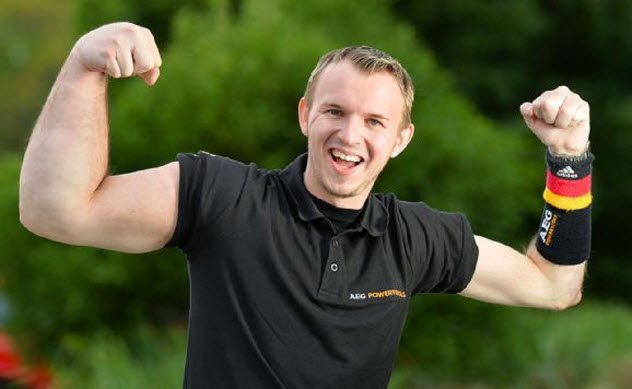
For those of you wondering, the person in this post's header photo is Matthias Schlitte, a German professional arm wrestler. Matthias was born with a genetic condition that made his right arm stronger than his left and, in a great illustration of "when life gives you lemons" he parlayed that into a successful arm wrestling career (and now television commentator).
 What If...
I had a quick tangent on this topic that didn’t really fit in the flow of the post but that I wanted to include for your consideration.
Should you ever find yourself in an interview and someone asks “What’s your greatest weakness,” my free advice is to talk about overusing one of your strengths and what can/has happened as a result of that. It not only shows a level of self-awareness that other candidates may not necessarily have but it also allows you to turn the question around to instead talk about one of your many strengths.
LikeLike