

More than a decade ago, an IT friend of mine first introduced me to the Gartner Hype Cycle and I was equally parts amused and impressed with the it. (For those of you not familiar with them, Gartner is a technology research and consulting company and they were one of the handful of consulting firms that our IT department relied upon.)
Gartner produces a lot of interesting research and I find that their Hype Cycle can be used to describe the path that a lot of things take from new products to projects to life in general.
For illustration purposes, here’s a recent example of a Hype Cycle they did on Artificial Intelligence:
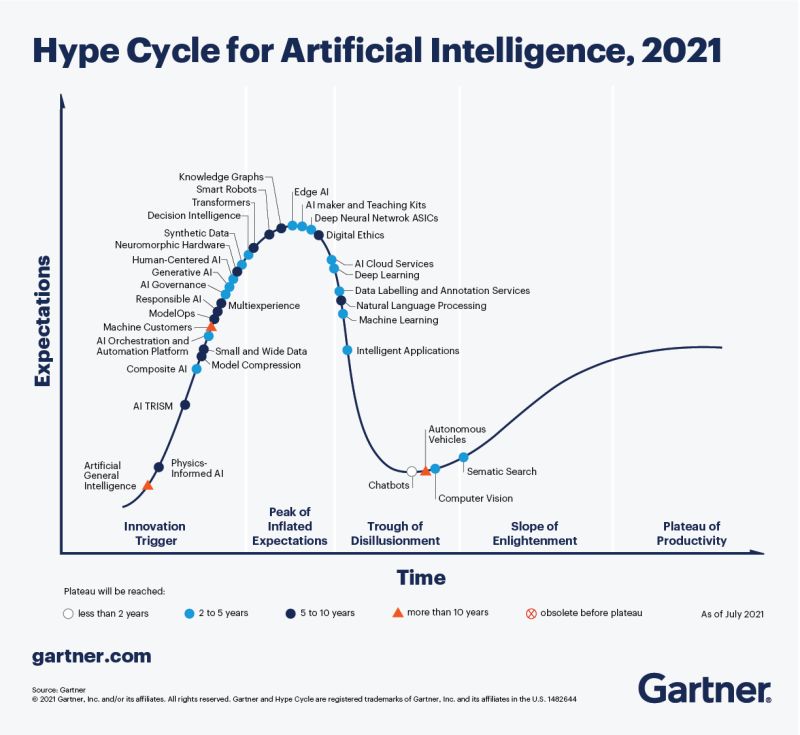
While this is an interesting piece of research by itself, I’m not going to focus on the contents of this particular study but wanted to use it to highlight two broad observations: the five stages that things typically progress through and the overall shape of the experience (the line). Let’s start with the five phases:
- Innovation Trigger (or Product/Project Kickoff). Every journey has to start somewhere and that’s what this point represents. An idea, product or project gets put forward, we start learning about it and, if there’s enough buy-in, then we start making some forward progress
- Peak of Inflated Expectations. I’ll ask forgiveness from my friends in sales but the best illustration I can think of is the stereotypical salesperson who comes in and is so eager to make the sale for whatever they’re selling that they paint an overly optimistic picture, telling you everything you want – and more! – is included and that you’re about to make the best decision of your life. I’ve been there many times myself and, while I should know better, the hype often gets to me
- Trough of Disillusionment. At this point, you’ve bought in, things are underway and you are really getting into the weeds, discovering all the “gotchas” and the caveats that go with those glowing promises. “Sure, you can do that… but you need to buy this add-on” or “That feature should be out sometime next year” or just a simple “Well, this doesn’t work the way we thought it would.” It’s not uncommon to reach a point where you fear that, instead of being your most successful effort ever, it could, instead, cost you your job
- Slope of Enlightenment. You have hit and gone past your low point, are now a lot smarter and your eyes aren’t so filled with stars. You’re making more realistic projections of what is possible and typically recognizing that the outcome is not as bleak as you’d feared. You also know that it’s not going to be as great as you thought originally either but the dark clouds are starting to part and glimmers of daylight are peaking through
- Plateau of Productivity. You’ve finally arrived… and things turned out pretty well. Maybe not as well as during the height of the sales pitch, perhaps, but also not as bad as you’d feared in those darkest days in the Trough
What this describes is a process of gaining knowledge and perspective; a maturation of your expectations as you learn more and go from a simpler, more shallow understanding to getting into the real details and finding out what is truly possible. This journey is true in many areas of our life from projects at work or making a major purchase to having a long-term relationship. The irony for me is that this technology-focused Hype Cycle from Gartner can actually be applied to a lot of areas of life.
Of course, something that’s stuck with me over the years were the phrases they used – especially the “trough of disillusionment” and the “peak of inflated expectations.” While most of us don’t talk like that, those words do a great job of conveying the roller coaster ride that often accompanies our work and personal lives. And with that lead-in, let’s turn to examining the trend line and how it tends to look like a roller coaster.
You start at pretty much the bottom as you are unaware of the product or the need to undertake the project. In those early days when it’s all concepts and getting buy-in, our expectations can become hopeful and fairly unrealistic over time. The anticipation and optimism can be in full effect with a real sense of excitement. Then, when we actually start to move forward and reality sets in, those same expectations can bottom out and we can end up close to where we started wondering if this was even worth the effort. But for most of us, we push on and we often end up in pretty good spot, somewhere between our deepest depths of despair and our overly-optimistic early expectations.
While this is not an exact science or formula that we can use to calculate the path of all our endeavors, I find that this graph does a nice job of conveying the journey we’re likely to take. And more importantly, I find real value in reminding myself that this familiar path will likely repeat itself with whatever I’m starting. As a result of that, it helps me to manage expectations both during the rise and fall of the expectations.
I will often try to temper the wild enthusiasm in the initial build-up by encouraging myself and others to apply critical thinking and to dive deeper into some of the details earlier on in the process. It can be a bit of a wet blanket as it takes away some of the excitement but I’ve found that doing this helps to lessen the impact during the true learning phase and it helps keep the team’s moral up when we run into challenges and disappointments.
Put another way, I believe that looking ahead to what is coming (reinforced by what we’ve experienced in the past) is a really helpful way to manage these sometimes wild swings that life can take. That’s not to say that there aren’t terrible things that can happen or, conversely, that some people don’t win the lottery, but as a general rule, this pattern bears out and preparing yourself for these ups-and-downs can really help balance things out.
As a final, more personal example, I thought about my relationship with my wife. The Hype Cycle started with my realization that this attractive lady might actually go out with me and then there was the thrill of spending time together and enjoying each other’s company. As we got more serious and I proposed (and she accepted!), we were both caught up in the romance and young love that often accompanies newlyweds. We were definitely living in our own “peak of inflated expectations.” Thankfully, we had older and wiser couples counsel us that marriage was a lot of hard work so that when reality eventually set in and we came into our “trough of despair,” we had the perspective to realize what was happening and could take steps to help us not only get through those tough times but emerge stronger as a result.
And that’s ultimately what I’m hoping to convey here to you… that life has its continual ups and downs but that we never stay in the same place forever. When you are up, enjoy the thrills & excitement and appreciate what you have in the moment. And then don’t lose sight of those good times when you fall into the next “trough” because, assuredly, there’s another peak coming up ahead. That’s the roller coaster of life.
So enjoy the ride and know that I’m pulling for you!
 What If...
Leave a comment