

Last week, on October 29th, the Internet turned 50 years old. It was on that day in 1969 that the first message was sent between two networked computers over ARPANET, the forerunner of today’s Internet. The message? “Lo”… which, in an ironic foreshadowing of computer headaches to come, was supposed to be “Login” but the system crashed partway through. Thankfully, it worked on the second try.
To mark this milestone, the Pew Research Center recently surveyed 530 experts in various fields to see what they think the next 50 years will bring. Some of their predictions are startling, others are familiar, but one theme I found particularly encouraging – 72% of their respondents think that people’s lives will be changed for the better. (In full disclosure, the PRC notes that this is “a non-scientific canvassing based on a non-random sample,” so take the stats with a grain of salt.)
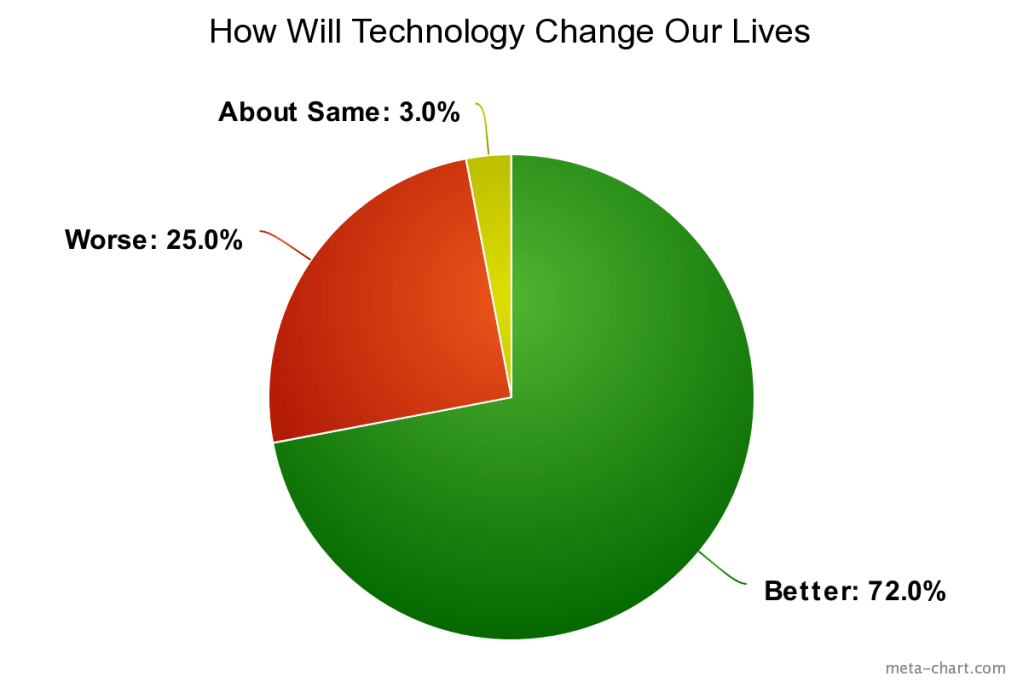
Still, a lot will depend on what we choose to do with the Internet. In the most simplest of views, the Internet is a tool and, like any tool, it’s value to society will depend how we use it. A hammer can be used to build a home or to smash thumbs. Likewise, having ready access to information and online resources can – and already has – empowered us to better ourselves by providing access to information or helping people connect to one another the world over. But at the same time, we’ve wasted untold hours online and often put the worst aspects of ourselves on display in the belief that we are safely anonymous. What we choose to do with this Internet tool as it becomes more even more capable and pervasive will determine whether our upbeat prognosticators are right.
Personally, I think there are reasons for concern based on what’s happened in the last 50 years. On the whole, while I think the Internet has largely benefited humanity, it certainly has not been a total success. We will face challenges or even real dangers in the years to come: the further erosion, and perhaps elimination, of our personal privacy; the ethical questions that arise from technology that can be plugged directly into our brains and bodies; or even the increased abilities by governments to monitor our activities. As one observer noted, George Orwell’s 1984 might be in our future, not our past.
Anyone who’s followed me or read my other posts know that I’m generally an optimist at heart (I even called myself a hyper-optimist in an article this past year). But even as someone who believes that good will ultimately triumph, I recognize that it’s not a guarantee and that we all have active roles to play to ensure that what comes tomorrow is better than what is today.
And that’s why I really appreciate what the Pew Research Center has done. By asking people for their thoughts about what may lie ahead, it affords us the opportunity to think about those possibilities and determine what we want to see happen as we approach a century online. To that point, I again encourage you to review the research and see what you think.
Know that I’m pulling for you!
 What If...
Leave a comment