

This concept of urgent not always equating to important is something I readily admit to still struggling with. I was raised to try and help whenever I could and so when someone comes to me with something that they feel is urgent, I tend to react in kind. But the reality is that doing so is not always the right choice.
Looking at this objectively, the concept makes a lot of sense. Everything we face is either going to be urgent or it can wait. It’s also may or may not be important and, using those two criteria, you can start to categorize every request that you receive. Steven Covey covers this in his books by presenting the options in a simple, four-quadrant diagram:
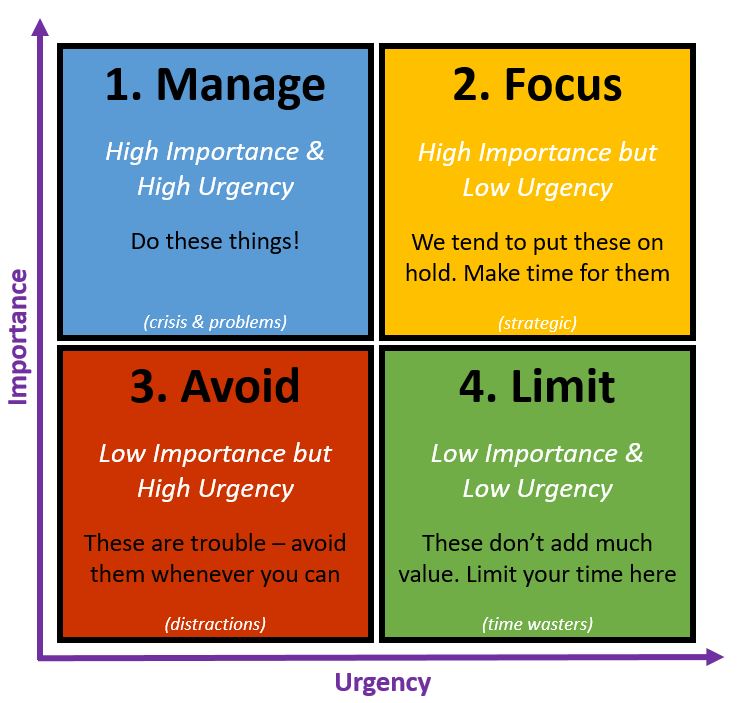
The things that are urgent and important should, obviously, shoot to the top of our lists. Things that are unimportant and can wait will, ideally, do just that – wait. But it’s these other two quadrants where things get dicey and I want to focus especially on the Urgent but Unimportant things.
Think about it. How many times have we been hard at work when we get interrupted by something that’s not as important in the grand scheme of things? Perhaps it’s a text message on our phone or someone who needs help on wrapping up something before they head out on vacation. They can seem urgent but do we take the time to see if they’re important enough to jump ahead of what we’re already working on?
Personally, I have this strong, almost overriding, desire to lend a hand however I can if one is asked for. Not doing so just seems wrong to me. I can help, therefore I should is how I tend to view it. But that’s where I think I go wrong at times.
I am not advocating a “to hell with the rest of you” mentality where it’s me first all the time, but we do need to be disciplined enough to weigh new requests as they come in and make that assessment as to whether their importance is higher than what we’re doing right now. If so, no problem. Let’s get after it. But if not, then how do we handle this and not come across as an uncaring jerk?
I heard a story from an executive one time where he said that when his company was first starting out, everyone pitched in and did everything. One of his unique skills was fixing their copier which jammed frequently. As a result, one of his employees always came to him first when it happened. His usual response was to stop whatever he was doing and go fix the problem because he could. But then, as the business grew and demands on his time increased, he started to ask the “should I” question and realized that the task of fixing the equipment really belonged to someone else, someone whose job was to keep the office equipment running. His job, as the leader, was to focus on the things that he was responsible for, like driving sales or figuring out strategy. By allowing himself to be distracted, he realized that he was actually harming everyone at the firm by not doing his job.
Sounds reasonable, right? Then how do we go about doing that? It’s a work-in-process but I’ll share what I’ve been trying:
- Run a little interference. If possible, shut down or mute your email and phone and close your office door. You can’t always do that but if you can, try it. That’ll help filter out some of these potential distractions by letting them self-eliminate
- Set the proper tone. If you do get interrupted, acknowledge the person who’s caused the distraction but don’t be overly warm or cold. I try for a mildly friendly but questioning look but allow my body language to indicate where my focus is still pointing… probably at my computer with my hands hovering over my keyboard or towards a report I’d been reading now with my finger holding my place
- Push back gently. I do so by saying something like “Oh, hi Bob. Good to see you. Hey, I’m actually in the middle of something pretty important here. Is it possible that this can wait until later?” If it can, offer a time for when you are free and then get back to what you were doing. If your visitor says it cannot, then continue on with the conversation
- Try and time box it. Ask them if you can keep this to a couple of minutes. If their issue is critical – say the building is on fire – that should become apparent from the start. But assuming it’s not quite to that level, this sets a clear expectation of what you’re both aiming for
- Dive in. This part of the conversation could be its own post but, ideally, you and your colleagues should be experts at conveying information quickly. Regardless, keep on target and try to get at the heart of the issue as quickly as possible
- Make a judgement call. If the issue is more important that what you’re working on, change your focus. If it’s not but there is still some importance to it, try offering suggestions and alternatives to empower your team member to pursue a solution. And, if needed, schedule that follow up time
Now, after sharing all this advice, I’ll admit to something I still struggle with that runs counter… the philosophy that “My door is always open.” I have tried to follow that for years as I thought it made me a better manager and servant leader.
However, as I’ve reflected on this “urgent is not always important” thread, I’ve come to realize that my open door policy may have been a mistake. Rather, it might have been better to say “I’ll never get mad at you if you knock and come in” as that acknowledges that things I’m working on may be pretty high priority but that I’m still there for my team.
There’s one last wrinkle I wanted to cover here – what do you do if your teammate thinks something is really important and you do not?
I don’t know if there’s a simple answer to this as you’ll likely need to spend some time with them either way. But a part of that conversation should be dedicated to providing context and perspective – and bear in mind that it goes both ways. Give your people a chance to make their case and change your mind. Conversely, explain why you think what they’re bringing to you is not as important as other things you are facing. It’s these teachable moments that are really investments into each other and help us all do better with each new challenge.
I hope the above makes your own journey through sorting out urgent and important items an easier one. And know that I’m pulling for both of you!
 What If...
Leave a comment